Syriatel.. an Establishment? Or an Intelligence Branch

SYRIATEL .. an Establishment? Or an Intelligence Branch?

Omar Al Assil

5 April 2012

I wrote, about a year ago (27 April 2011), in a blog: (SYRIATEL .. with or against us?) about Syriatel Mobile Operator and their exclusion policies, by tracking its employees’ news and writings on the Facebook, terminating those who seem to be even only empathizing with the demonstrators. I wrote about special cases where I was an eye-witness.
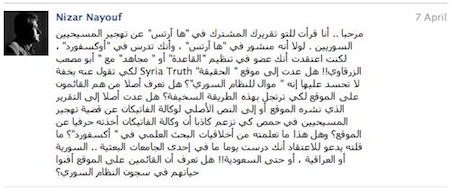
The events have not stopped since I published that article. Investigations were directed to find out the writer, and punish him. They did manage to get to the company I worked with, and, using their relation with its management, passed their complain, suggesting the termination of my contract with it. For their misfortune, the company was a foreign company, and it ignored their request. استمر في القراءة

Syrische Emigranten Organisatie zegt dat de Syrische historische sites en overblijfselen in gevaar zijn

24 April 2012 

De Syrische Emigranten Organisatie (SEO) brengt de vernieling van Syrische historische sites en overblijfselen aan het licht, veroorzaakt door het voortdurende conflict. Al langer dan een jaar woedt het gevecht voor een vrij Syrië, ongeveer10 000 mensen zijn gestorven en er wordt gezegd dat de humanitaire situatie onheilspellend is. Terwijl dit terecht heel veel aandacht krijgt, wordt weinig gesproken in de mediaover de schade die aangericht wordt aan het erfgoed van het land.

In het persbericht wordt de oude Qa’laat al Madiq citadel dichtbij de stad Hama onder de aandacht geplaatst door SEO. De citadel dateert uit het 4e millennium vgt. en YouTube beelden van Al-Jazeera tonen dat de zuidelijke muur van de citadel onder vuur staat door het Assad regime. Dit zorgde voor enorme structurele schade. Er wordt ook gemeld dat het leger van Assad archeologische sites van Syrië gebruikt als militaire basissen.

استمر في القراءة

Flood in Baath Land, Documentary by late Syrian director Omar Amirallay

ولد عمر أميرالاي (1944- 2011) في دمشق من أسرة لها أصول شركسية وتركية وكردية وعربية. درس المسرح في جامعة “مسرح الأمم” في باريس عامي 1966-1967، ثم التحق بالمعهد العالي للدراسات السينمائية في باريس، لكنه انقطع عن الدراسة بسبب أحداث الطلبة عام1968. عاد إلى دمشق عام 1970.

Omar Amirallay (1944-2011) was born in Damascus, he descended from a family with Sacristan, Turkish, Kurdish and Arabic roots. In 1966-1967, he studied at the university of “the theatre of nations – Théâtre des Nations), then joined La Fémis (École Nationale Supérieure des Métiers de l’Image et du Son) in Paris before he had to stop his study due to the events of the students in 1968. He returned to Damascus in 1970.

استمر في القراءة

نزار نيوف، “الحقيقة”، والمسيحيون السوريون

أيمن جواد التميمي

23 نيسان/أبريل 2012

كشف وفضح التضليل الإعلامي المؤيد للأسد وحملة تشهير

في مقالة كتبتها مع كاتبين آخرين لجريدة هآرتس Ha’aretz يوم 6 نيسان/أبريل، قمت باقتفاء أثر الادعاء المنتشر بكثرة حول التهجير العرقي الذي قامت به ميليشيات إسلامية بحق 90% من المسيحيين من مدينة حمص السورية، ووجدت أن الادعاء مصدره موقع “الحقيقة”. على الرغم من أن هذا الموقع يدعي أنه يعارض نظام الأسد وينتقد أيضاً المعارضة السورية، إلا أنه يصنف بدقة من قبل معهد الأبحاث الإعلامية في الشرق الأوسط MEMRI بأنه موقع موالٍ للأسد. إثر كشفي لأمر الادعاء المريب، تلقيت رسائل بذيئة على “الفيسبوك” في اليوم التالي من صحفي سوري اسمه نزار نيوف، وهو حالياً منفي في أوروبا. بدأ بقوله: “لولا أنه منشور في هآراتس، ولولا أنك تدرّس في أوكسفورد (مع العلم أني طالب هناك) لكنت اعتقدت أنك عضو في تنظيم القاعدة أو مجاهد مع أبي مصعب الزرقاوي!!”. وأضاف كذلك اتهامي بالعمل مع العنصري الأمريكي الإسرائيلي دانيال بايبس Daniel Pipes.

استمر في القراءة

Experts of Death Documentation Like Us Do not Cry

Syrian Women for Human Development

Experts of Death Documentation Like Us Do not Cry

Razan Zaitouneh, April 22, 2012

Razan Zaitouneh

I need to watch more videos for the martyrs to be sure of the martyr’s name and the details of his martyrdom; tens of videos daily; and during the periodical review, I watch hundreds in the few hours of the day. The average for watching each video is one minute. Within an hour, sixty bodies could be watched, unless the videos were for mass murders, then the number is multiplied.

Body after body: some are in shrouds, whereas others are still covered with their wounds and blood. Some faces seem to be panicked and shocked: Is this you, Death? Other faces look asleep for the absolute tranquility appearing on their features… Some are beautiful with soft skin and little primed mouths and a ghost of a smart smile. The martyred children and their eternal tampering with our souls.

The female martyrs are the less present on videos. You need to draw the martyr’s features in your imagination. The female martyrs leave in silence on YouTube. Most of the time, we cannot attend the rituals of pain in the first moments of their absence.

But the hardest videos are for the martyrs in their death throes. In such cases, you find yourself obliged to respect their moments and not to move on to another video or to a new documentation. You have to hold the hand of this person suffering in front of you on the computer’s screen, to look deeply in their eyes even if the pain is pulling out your eyes, and to hear their final whispers. They might say something in the language of the space lying between life and death. They might be sending an apology to a lover or a word of longing to a mother, or they might only be singing… You just want to listen, but the people surrounding the suffering body don’t give a chance to receive their message. The scream around the injured: say the credo, say the credo… If I were in their place, I would probably wish to be told that I would live longer and longer, to close my eyes on a beautiful hope that I would be back to my beloved ones, or to be hugged by someone who would wipe my head silently in my last moments.

استمر في القراءة

Les chrétiens de la Syrie et le régime en pouvoir

Article in English

المقالة باللغة العربية

La Syrie et le régime en pouvoir

      La Syrie est une des pays du Proche Orient dont la population s’élève à des 20 millions d’habitants, gouvernés par le parti Baath depuis 1963, et par la famille El Assad depuis 1970. Il s’agit d’un régime totalitaire, dictatorial, qui consacre le centralisation du pouvoir entre les moins des membres d’une éthnie religieuse représentant environ 10%, des habitants du pays, qui sont les Alaouites. Ceci constitue un exemple claire de l’oligarchie.

Pour bien éxercer un contrôle stricte des affaires du pays, plusieurs appareils de sécurité ont été créés, jouissant de autorisations indéterminés, ces appareils tiennent concurrence entre eux pour jouir de la satisfaction du président.

Parmi ces appareils citons : la Sécurité de L’Etat, la Sécurité Politique, Le Service Général des Renseignements , les Renseignements Militaires, Les Renseignements des Forces aériennes ….

Le régime au pouvoir à imposé la loi d’urgence le long de 40 années ; cette loi facilite, et réglemente les violations des droits de l’homme et du citoyen, et elle est toujours en vigueur jusqu’à présent  bien qu’elle a été théoriquement annulée depuis des mois.

Il s’agit d’un régime militaire ne savant que la violence et les chantages comme moyen pour traiter avec autrui, peuple ou pays. Les dérnières années et décennies sont témoins d’innombrables violations quantitatives et qualitatives des droits élémentaires de l’homme: poursuite, violation de la vie privée, arrestations, torture systématiques, massacres à Palmyre, à Alep et à Hama.

La déclenchement de la révolution syrienne.

     Il y a presque un an, une importante masse du peuple syrien s’est révoltée en voyant l’exemple en Tunisie, en Egypte puis en Libye, brisant le barrière de la peur dans un pays qui fut surnomme « Le royaume du mutisme ». Sa révolte a trouvé une violente suppression qui a dépassé les limites. Une suppression qui est arrivée à bombarder les quartiers peuples par les chars, les mortiers et les missiles.

استمر في القراءة

Todesdokumentations Experten, wie wir, weinen nicht

Razan Zaituneh

Razan Zaituneh

22-4-2012

Um den Namen des Opfers und die Details seines Todes richtig dokumentieren zu können, soll ich mir mehrere Videos von den Opfern anschauen. Es sind täglich Dutzende von Videos zu sehen, und während der Routinekontrolle der Datenbank sind sie hunderte in den wenigen Stunden des Tages. Eine Minute für jedes Video: innerhalb einer Stunde sind 60 Leichen zu sehen, nur wenn es Massentötungen gibt, dann verdoppelt sich die Zahlen.

Viele Menschen hintereinander, manche sind in Leichentüchern, andere sind frisch getötet, bedeckt von Wunden und Blut. Manche Gesichter mit Panik-Ausdruck … bist du es, Tod? Manche Gesichter, mit Wahrzeichen Frieden, scheinen normal schlafend … Einige sind schön mit feiner Haut und kleinen geschlossenen Mündern. Ein schlaues Lächeln ist was davon geblieben… Kinderopfer und ihr ewiges Spiel mit unseren Seelen.

Märtyrerinen erscheinen kaum in Videoclips,meistens sollten ihre Gesichtszüge aus der Fantasie gezogen werden. Frauen verlassen das Leben lautlos in YouTube. Es erlaubt uns oft nicht, an den ersten Momenten des Schmerzen-Rituals teilzunehmen.

Doch, die härtesten Videos sind diejenigen, in denen die Märtyrer bei ihrem Sterben gefilmt werden. Man findet sich gezwungen, den vollen Respekt vor ihren letzten Momenten des Lebens zu zeigen und nicht aufhören zu gucken, um neue Dokumentation anfangen zu können. Man soll virtuell die Hände des Opfers nehmen, in seinen Augen, trotz eigene Schmerzen, schauen und ihm zuhören, ob er bei seinen letzten Rasseln was sagt. Man will hören, was die letzten Worte dieser Sprache vom Übergang in den Tod sagt. Vielleicht entschuldigte er sich bei seiner Beliebte, zeigt er Sehnsucht nach seiner Mutter oder singt er nur … man wünscht sich, dass die Leute neben dem schwer verletzten Körper auch zuhören, leider machen sie das nicht. Sie geben uns die Chance nicht, die letzte Nachricht von ihm zu erhalten. Sie Schreien: “zeig dein Glaubensbekenntnis, zeig dein Glaubensbekenntnis” … Wenn ich in seiner Stelle wäre, würde ich mir wünschen, dass sie mir sagen, dass ich weiter und weiter leben könnte; dass ich meine Augen schließe und vom Wiedersehen mit meinen Geliebten träume. Oder vielleicht , dass ich in meinen letzten Momenten von ihnen umarmt und lautlos über meinen Kopf gestreichelt werde.

استمر في القراءة

The Revolution of Dignity – How it All Started – Syrian Documentary – English Subtitles

Horan is a region in southern Syria famous for its plains and agriculture farmlands. One of its main cities is Daraa, where the Syrian revolution had its great beginning…

Mrs Montaha al-Atrash is a prominent human rights activist. She is a princess, the daughter of the late Sultan Basha al Atrash who led the Syrian revolution against the French occupation. She is the spokeswoman of the Syrian Organization for Human Rights.

This is her words in the begining of the film:

“My dear these events started with children, I can’t believe a regime would punish children 12 and 13 years of age, just because they wrote on the walls: The People Want to Topple The Regime”.

Similar to other revolutions, as part of the Arab Spring, Syrians have given names to each Friday since the start of their revolution. Friday is the day in the week where demonsrations reach their peak. The Friday names are either symbolic general phrases, or political messages or terms used to raise awareness of certain issues or demands.

This film documents the begining of the Syrian revolution in Daraa.

What exactly is the Freedom the Syrians are seeking

Odai Al Zoubi – Syrian writer

25/3/2012

There are still some people, perhaps innocently, asking what exactly is the Freedom the Syrians are seeking? Can the revolutionaries formulate a crystal clear concept of Freedom? Won’t the Syrian revolution present a risk to the Syrian society as a whole in case the Salafists took control of the State of Syria? Aren’t the Syrians risking replacing one despotism with another?

Those people are seeking a comprehensive vision of the concept of Freedom along with a clear picture for the future of the revolution and the nature of the desired regime.

The protestors and the revolutionaries are providing answers that do not appeal to the regime supporters nor those who are sceptical of the revolution. The answer of the protestors is decisive and final. We are here to topple the regime. Everything else is just details. This article is an attempt to explain the reasons why the protestors’ answer is the only acceptable and ethical answer. Any scepticism of their answer springs from unethical attitudes that ignore reality.

From a philosophical perspective, the answer to the question of Freedom arises from the circumstances the people are living. The question of Freedom is the question of Syrians living under a dictatorial regime since forty years ago. The answer to this question is their answer. Anything else is pure ranting that is not related to the lives of the citizens and does not take into consideration their circumstances, tragedies, hopes and aspirations. Any answer that does not take into consideration the specific realities in Syria is not a satisfactory answer. This analysis of the concept of Freedom extends to other concepts. The revolution is the revolution of the Syrian people and only they are able to give a true meaning to the revolution through their practices and choices.

Why do Syrians believe that toppling the regime is the means for attaining Freedom and everything else is just details?

Let us consider both the regime’s and opposition’s perspectives on Freedom.

استمر في القراءة

A Child Testimony of Bashar’s Crimes

After more than a year of destruction and chaos, Syria’s children are now aware that not only it is violent people who have taken away their families and demolished their houses, but also that there is a higher authority above them giving them orders, and it is their president, Bashar Al-Assad. Children are now forced into understanding this complex concept of “politics”.

Source:

Youtube