Part 1: 10 Minutes in Jouret Al-Shayyah in the city of Homs, this is how it became now.
A man riding a motorized bike attempts to document the events that are taking place in the neighborhood of Jouret-Al Shayyah in the city of Homs.
Source:
A man riding a motorized bike attempts to document the events that are taking place in the neighborhood of Jouret-Al Shayyah in the city of Homs.
Source:
al-Houla’s Media Office
13/06/2012
A statement from the residents of al-Houla, families of the victims of the massacre, and survivors in response to an article published by Frankfurter Allgemeine Zeitung, which claimed falsely and deceitfully that the victims of the massacre were individuals of the Alawite sect and that they were killed by the Free Syrian Army in al-Houla.
—————————————————————–
We write this letter in the name of the residents of al-Houla استمر في القراءة
Sara Siriana
29/maggio/2012
Oggi, in Siria come nel mondo arabo, ci troviamo nel pieno della tempesta, donne e uomini. La fragilità del “femminismo” in Siria ci ha sorpreso, in quanto è una patina brillante, ma vuota. Quasi un anno e due mesi sono passati dallo scoppio della rivoluzione, ma la donna siriana non è ancora in grado di produrre un proprio discorso politico-sociale. La sua presenza nelle riunioni politiche è ancora limitata e formale, ogni incontro tende a mettere in evidenza una signora o due, per sfuggire alla solita domanda: “dov’è la donna (la metà della società) nel vostro incontro?”.
Activist Khaled Abu Salah is talking about the situation of the last makeshift clinic in HOMS, the city that lives under the continuous barbaric shelling by the Assad forces.
Amman – Tamer Al Smadi
Monday June 4th, 2012
 Amal (40 years old) and her daughter found safe passage to Jordan from the area of Bab Amr ( باب عمرو ) in the Syrian city of Homs, fleeing the killing spree that according to her took the lives of three of her daughters at the hands of the Security Forces and those who are known as the Shabiha .
«Youth / Shabab» supplement observed tales, shrouded in the heavy dark Damascene night, of Syrian women raped and murdered, to convey to you their and their families’ ‘rare’ testimonies.
Badrakhan Ali
28 May 2012
[The following article was translated into English by Christine Cuk.]

Kurdish inhabited area of Syria. Image from Wikimedia Commons
The Kurdish issue in Syria has a history and trajectory that are different from sectarian problems in the region. It is not a sectarian problem, as the Kurds are not a sect of Arabs or a special Islamic group. They belong to a people that are forty million strong and are distributed over a number of countries, and they are the largest national group in both the region and the world that is deprived of a political counterpart to its existence: an independent state. The aspects of the region’s Kurdish question differ from the revival of sectarian problems in Arab-Islamic society.
Malek Daghestani
Friday 1st June 2012

He was serving in the area of Al-Sanamin when the Syrian revolution broke out. When First Lieutenant Abdulrazzak Tlass heard for the first time the voices of the demonstrators from his residence, he found himself without much thought, driving his car to the scene of the demonstration, wandering around the demonstrators, looking in astonishment and admiration at the courage of these young Syrians. At that moment, he realized that these young men have crossed the fear barrier that the regime has imprisoned the Syrians behind for so long, which he also recognized from within the Military establishment to which he belongs.
Mhyd Mohammad al Zhwry
An Artist and Calligrapher from Qosair
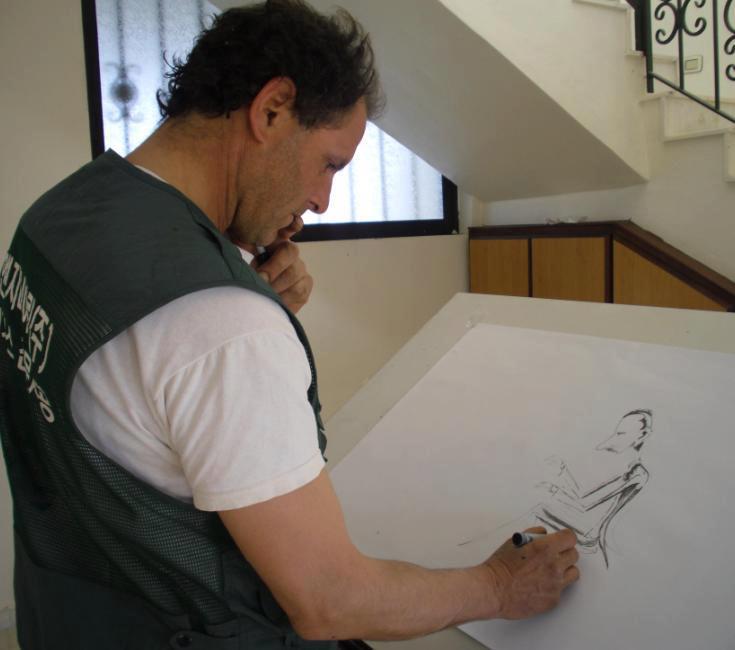
Mhyd is a Syrian fine artist from Qosair in the Homs countryside who loved the plastic arts and oil painting. With the advent of the Syrian revolution he turned to painting the banners for the demonstrations.
Ziad Majed
Tuesday, July 5, 2011
Perhaps the best invention to come out of Facebook is the clicking on “like” to express admiration, appreciation, love, compassion, and acknowledgement or to show courtesy or all these combined. This small link, the “like”, can be used for a “page”, a person, a cause, a book or an event as well as when coming across a photo or following reading a comment or post, or even a comment on a comment or a post. It becomes addictive after getting used to it as one feels an urgent desire to have such a tool in hand, clicking it in secret and suddenly bringing it out if he/she likes something or someone or a voice or a speech or any scene whether he/she is walking down the street, at home, university, a café or any other place. Furthermore, one can imagine a society armed with the “like” links which can be clicked left, right and centre, and released in celebrations which convey “on the ground” a communal sense of unity in emotions and excitation.
Arab Intellect Azmi Bishara
1 May 2012
When a regime sends in tanks to shell its own people in their cities and residential neighbourhoods, the natural ‘instinct’ reaction expected from any ethical person is to stand with the people against the regime. In such a person’s opinion, the regime, whether it was democratic or not, becomes illegitimate if it finds it necessary to kill, repress, and torture people en mass in order to stay in power because the people no longer accept it or can no longer tolerate living under its rule.
There is a moral defect in a person that finds himself justifying killing as a mean to respond to a conspiracy or for the sake of a noble goal the regime is claiming to be working for forgetting the pain of an entire nation in the process. Such a person will lose his humanity and defame himself while he is ranting about conspiracies.
 المترجمون السوريون الأحرار | Free Syrian Translators