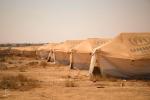
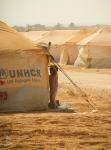
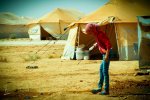
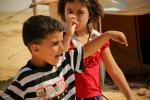
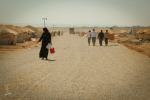
Za’atari Syrian Refugee Camp in Jordan

A mass refuge, a large grave where death lines up

Source

Interview with Father Paolo Dall’oglio – مقابلة مع الراهب باولو دالوليو

Source: Al Arabiya News Channel
Broadcast on 21st June 2012
Anchorwoman (AW): Giselle Khoury
Guest (FP): Father Paola Dall’oglio

If you don’t mind, I’d like to end this interview,
…by wearing this vest that represents a project.
We want to serve the reconciliation.
These are olives branches,…
…and these are the colors of our country.
Those are our martyrs.
Reconciliation is our future, and we are committed to it.
There is no reconciliation without a mature democracy,…
…without freedom of opinion, and true humanity.
Syria is heading towards good, peace and reconciliation.
Peace be upon you!

An Appeal from Syrian Christian Intellectuals to His Holiness Pope Benedict XVI

In the name of the Father the Son and the Holy Spirit Amen

Your Holiness Pope Benedict XVI

We are a group of [Syrian] Christian intellectuals loyal to our Lord Jesus Christ and the teachings of our Church. And we know well, away from any personal benefit, the nature of the Syrian people and the truth of their revolution.

Syria has contributed to humanity during all of its prosperous periods and has spread love and good. On its land the Lord Jesus walked and the Apostle Paul launched his message.  Its archeology speaks for the depth of Syria’s spirituality and contribution to humanity.

استمر في القراءة

Faces from the Syrian Revolution: Anas Al-Sheghri

Anas Ali Al-Shegri, born in 1988 in the village of Baida near the city of Baniass. He was a third year student at the School of Economics at Latakia Tishreen University. He became a leading activists in the peaceful protests during the popular Syrian uprising.

Anas is considered one of the most popular person in the city of Baniass. He played a leading role in the flare-up of the protests that called for freedom and toppling the Regime in the city of Baniass which is considered the second rebellious city in Syria after Deraa.

استمر في القراءة

Report on The Humanitarian Crisis in Deir Ezzor City

Given the lack of coverage of the humanitarian crisis that is unfolding the the city of Deir Ezzor following weeks of siege and shelling by the Assad forces the Free Syrian Translators will reproduce the following report on the situation in that city.

Report on The Humanitarian Crisis in Deir Ezzor City – By Obaida Hitto ::

استمر في القراءة

The Conditionality of some Intellectuals

Although the author directs this article toward “elitist” and “recalcitrant” Arab intellectuals the Free Syrian Translators Team feel that the same criticism can be directed towards many international “experts” and “analysts” on the Arab region, for their lack of support of the Syrian Revolution and or “neutral” opinions.


Ziad Majed

Tuesday, July 10, 2012

Some Arab intellectuals have grown accustomed to contempt and disdain of their own societies as well as focusing their criticism on these societies under the pretext of their backwardness, them succumbing to tyranny, and their susceptibility to oppression. Yet as soon as these societies have risen in revolutions and uprisings (some of which are legendary by means of grit and courage) to overthrow tyranny and confront its consequences, those intellectuals have gone silent or started to dictate the conditions upon which they would decide whether to support these societies while they face the guns and knives, or remain “neutral”.

استمر في القراءة

A Citizen Journalist Filming his Own Death

Yes, the headline is true.

Ahmad Hamada, a young Syrian and an iconic Citizen Journalist.

He devoted himself for his work of video-documenting the brutal and barbaric crackdown of Assad’s militias on the city of Homs.

Listen with your hearts to his tone of voice, which is full of agony, despair, disbelief, and true pain at the sight of his beloved city being bombarded by Assad’s troops.

Being completely destroyed!

Little did he know, that his only weapon, his camera, would capture his own ascendancy to heaven as a martyr.

This promotional video contains clips that show a mere side of his work

A Dialogue with Zakaria Tamer

By: Ziad Majed

Posted on: June 5, 2012


“Before my departure from this world, I hope to sit in a Damascene cafe and swear at the top of my voice at all the Syrian officials without feeling intimidated or fearing arrest.”

Born in Damascus in 1931, Zakaria Tamer lived in its traditional working class neighborhoods, where he worked from a young age in blacksmithing and hand crafts, through which he came to know his society and people, the circumstances of their lives and their varied mentalities.

In 1957, he decided to enter the world of writing and chose short stories as his literary genre.

From 1960 until 1978, and between 1994 and 2005, several collections of Tamer’s short stories were published, including the “Neighing of the White Horse”, “A Spring in the Ashes”, “Thunder”, “Damascus of the Fires”, “The Tigers in the Tenth Day”, “Noah’s Calling”, “We will Laugh”, “Sour Grapes”, “Knee Busting”, and “The Hedgehog”. In addition, he published children’s stories, most notably “Why the River went Silent” and “The Rose said to the Sparrow”.

استمر في القراءة

The State of Barbarism

Ziad Majed

Tuesday, May 29, 2012

In 1986, a year after his abduction and experiencing the barbarism he has discussed and analyzed in his writings on Syria, Michel Seurat died in the southern suburb of Beirut, the Lebanese capital which was devastated by civil war and the grip of the Syrian Intelligence services.

Today, we remember his texts that have been compiled in the second edition of his book “The State of Barbarism”, with their ingenuity and pertinence, even though it has been three decades since they were first published.

In the context of the ongoing Syrian Revolution, we can contemplate two issues he addressed in his texts: the “Asabiyya” and “The conflict between Society and State”.

استمر في القراءة