Les funérailles de Yazan Al Rayess 18-7-2011
Yazan Al Rayess funeral
Including Fadwa Sulaiman speech
Les funérailles de Yazan Al Rayess 18-7-2011
Yazan Al Rayess funeral
Including Fadwa Sulaiman speech
“And Thus We Turned to Military Struggle” The Commander of Al-Ashtar Battalion in Al-Rastan
Friday 27th January 2012
A Q&A with Razan Zaitouneh
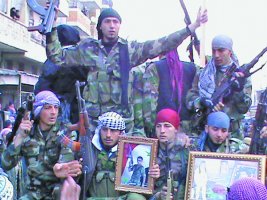 The Malek Al Ashtar division is one of two battalions under the “Syrian Free Army’s” Khaled ben Al Waleed brigade in the city of Al Rastan north of Homs. Its leader, Hasn Al Ashtar, is one of the most wanted individuals in the city. He has suffered various forms of persecution along with his extended family since the first few months of the revolution. This conversation sheds light on some aspects of the work done by the “Free Army” in Al Rastan, the negative aspects being attributed to it, and the debate on whether to militarise the revolution or keep its peaceful nature.
R: How did you and your family end up being ravaged and targeted by the regime? استمر في القراءة
Yassin Al Haj Saleh
It was clear that Sheikh Nawaf Ragheb Al Basheer was released, after two months of arrest, only after he was forced to appear on Syrian state television and say what the regime wanted to hear. It is also clear that the regime is not keen on hiding this fact. What they hoped for is not to convince Syrians about the contents of the Sheikh’s talk about the regime and the president, but rather to humiliate the Sheikh as a well known opposition figure.
Previously, the regime followed the same approach with Sheikh Ahmad Sayasenah, the Imam of al-Omari mosque, who is well respected in his hometown of Dar’aa. The aim was also to disgrace the man as a symbol and distort Syrians’ perception of him. The regime has no intention to prove that it is a just and dignified regime. The aim is to humiliate its citizens who oppose the regime and strip them of all dignity.
До начала арабской весны, Башар аль-Асад был уверен, что никто из сирийцев не осмелится бросить вызов его власти. Он просто привык к абсолютной и безграничной власти семьи Асад . Он же являлся сыном Министра обороны! Когда сирийская армия была поражена Израилем в 1967 году, вместо того, чтобы судить Министра обороны Хафеза Аль Асада, как было бы сделано в любом демократическом государстве, ему удалось совершить военный переворот и захватить власть полностью в 1970 году. Он поместил своих товарищей, которые были не согласны с ними в тюрьмы, пока они не скончались там. И привык десятилетиями заключать в тюрьму всех своих противников, как только они заявляли о своем несогласии с действующей властью, предотвращал появление каких-либо политических или не политических организации, организовывал для своей поддержки лояльные, «пустые» организации. Растерзал общественно-потенциальные силы, которые уже не в состоянии собраться в каком-либо коллективном действии. После чего в Сирии ничего не осталось из того, что может противостоять семье Аль Асад.
Башар продолжил путь своего отца. С расчетом что народ имеет право только аплодировать ему, почему нет? Он же сын Хафеза Аль Асада, который преподносил себя как святого и вечного лидер. Он возомнил себя священным символом, к которому не возможно было прикоснуться или приблизиться, и сделал свою власть Табу. Башар видел, как его отец делал Сирию усадьбой для своей семьи, и как собирался завещать сыну стать президентом. И чтобы стать им, Башар самовольно за одну минуту внес в конституцию Сирии соответствующие поправки, и никто не посмел ему возразить. И тогда вокруг него собралась толпа слабохарактерных и преданных ему собак, или же тех кому было выгодно в данной ситуации перед ним пресмыкаться.
Ziad Majed
Monday, January 2, 2012
How did despotism succeed in subjugating Syria during the Hafez Al-Assad’s era?
This article attempts to analyse the foundations of a despotic regime in order to understand the reasons underlying its success in exerting its control over a country, crippling political life, taming people, and maintaining its rule for many years. The article will take the Syrian regime between 1970 (the year of the “Correction Movement” which led Hafez Al-Assad to presidency) to 2000 (the year the president died) as a case study.
It is important to note that several aspects concerning the analysis of the father’s era and the study of the Syrian society under his rule are outdated and no longer relevant when analysing Syria during the last few years. In addition, the Syrian revolution brought into the light new events with regard to the regime’s alliances and the structure of society, which have been dealt with by a number of Syrian writers (and some of them still do), and whose documentation and analysis will require additional time.
On the origins of the “Baath” regime rule of Syria
The leading reason that explains Syrian regime’s success in taming public life, including all forms of political participation, social activities and civil conduct, is its ability to
Samir Sa’ifan – Al Quds Al Arabi
23 December 2011
Before the Arab Spring began, Bashar Al Assad was confident that no Syrian would dare to challenge his regime. He was used to viewing the authority of the Al Assad family as infinitely absolute. He is the son of the Defense Minister whose army was defeated by Israel in 1967, and instead of being held accountable, as the case in democratic countries ruled by institutions, he led a coup and seized power completely in 1970. He imprisoned his comrades who opposed him until they died in prison. He used to jail his opponents for decades just for initiating a political entity or issuing a statement. He prevented the formation of any political or non-political organizations, allowing only the creation of hollow and loyal ones. He fragmented all powers in society, such that it became paralyzed unable to carry out any collective activity. So, nothing was left in Syria that can threaten Al Assad.
Bashar Al Assad continued his Father’s approach; he never took the people into account, expecting them to clap for him always. Why not and he is the son of Hafez Al Assad who had labeled his ‘semi-sacred’ self with titles like “the Father Leader”, “the Eternal Leader” and the “Leader for Ever”, and enforced a pattern of viewing him as a sacred god that nobody can touch or approach, and made his power a taboo subject. Bashar Al Assad watched how his father was able to make Syria a farm of his own, and how he was able to bequeath him the presidency, and how the constitution was amended in a clowning session of the Parliament without any opposition from Syrians. He watched the queues of the lowly and the opportunist gathering submissively around him.
مدينة الرستن عصت على الاقطاع وعلى كل انواع الاحتلال، حتى الاسلام لم يستطع اقتحامها الا بخدعة من خالد بن الوليد تشابه حيلة أحصنة طروادة.
طروادة محافظة حمص، دخلها الجيش السوري بالدبابات، وقصفها لأيام، قصف بيوتها، مدارسها، جوامعها، واستباح كل تفاصيل الحياة المدنية فيها، دون مراعاة لأي حق من حقوق الانسان.
نساء تلقت القذائف في بيتها، وخسرت أبنائها، أطفال استقر الرصاص في أجسادها، وشباب رحلت عن الحياة، ورجال وقعوا فريسة لأمراض وآلام جسدية ونفسية من شدة التعذيب، ليس في السجون، بل في المشافي.. وتحديداً: مشفى حمص العسكري.
في الفيلم شهادات عن استهداف واغتيال النشطاء وتعذيب المرضى في السجون والمشافي، وشهادات لجنود انشقوا عن الجيش السوري، ليؤكدوا الرواية بما عاشوا وشاهدوا في درعا وإدلب.
جنازة لملازم أول انشق في اليوم السابق لاستشهاده، ومظاهرة مسائية تحية له ولأهله، ونصرة لحماه المحاصرة.
مدينة يُخْتَزَل منها رجالها، ويودَعُ في ترابها .. كل يوم .. أبناء لهم أمهات .. والأمهات تطفون على الحزن مثقلات بخساراتهن ..
إلا أن الكل .. والمدينة العصية معهم .. الكل يدور .. يدور .. يبحث عن شمسه، بالصبر، واليقين.
لم ولن يروا أمامهم من كل هذه الوحشية إلا النور في آخر الدرب: الحريّة.
دوار الشمس – الرستن – Tournesols – Al-Rastan
Al-Rastan city was insurmountable to the feudal landlords, and to all invaders, even during the Islamic conquests, Khaled Ibn Al-Waleed could only break in using a trick similar to the Trojan horse.
The Syrian Army broke into the “Troy” of Homs, with tanks, and shelled it for days, shelled the houses, the schools and mosques.
The army transgressed all details of civil life in it, with no consideration to any human rights.
Women whose houses were bombarded, lost their sons. Children bodies were torn by bullets… young men were killed, men were victims of diseases, physical and psychological pains, because of sever torture which was committed not in prisons, but in hospitals, in particular “Homs Military Hospital”.
This movie includes testimonies about targeting and assassination of activists, and torturing the injured in prisons and hospitals. In addition to testimonies from defected soldiers talking about what they witnessed in Daraa’ and Idleb.
And an evening demonstration in honor of a lieutenant who was martyred one day after he defected. People are saluting him and his family, and demonstrating in solidarity with the besieged city of Hama.
A story of a city whose men were killed and buried in its soil. Everyday, its sons die, leaving their mothers to live with grief, overburdened by their loses.
But, everyone of them, along with the insurmountable city, will go on, looking for their Sun, with patience and with certainty..
Out of all this brutality surrounding them they refuse to see but the light at the end of the dark tunnel, FREEDOM.
ورة الكرامة السورية 2011
Serhildana Namûsê a sûrî 2011
Syrische Revolution der Würde 2011
Syrian Revolution of Dignity 2011
La révolution syrienne pour la dignité
Достоинство Сирийской революции 2011
La Revolucion de la dignidad Siria
 المترجمون السوريون الأحرار | Free Syrian Translators