Yasin al-Haj Saleh
29/January/2012
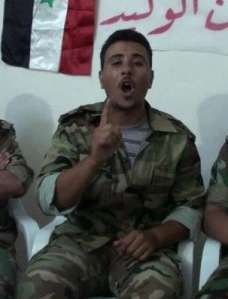
Without putting it in the context of 320 days of unrestrained violence that is practiced against it by the regime, there is no point in discussing the growing military dimension of the Syrian revolution nor the ongoing intellectual, political, and psychological transformations occurring in society and revolutionary environments throughout this bloody period. The regime tangled the military in confrontations at the focal points of the revolution, killing many of its members for refusing to shoot on their fellow citizens (Human Rights Watch report in December). As a result a number of soldiers and officers defected forming eventually a loose umbrella organization called the “Free Syrian Army.”
Cities and towns in the governorates of Deraa, Damascus’s suburbs, Homs, Hama, Idlib, and Deir Al-Zour were exposed to disciplinary campaigns similar to those of the colonial era, which prompted civilians to carry arms and confront the regime’s forces. We should not forget that it was the regime which from the beginning entangled civilians in the conflict on a large scale: the “Shabbiha”.
These circumstances, which are known to all, mean that the military component of the revolution is integral and thus it cannot be overlooked when thinking about it and planning it politically. This is not an external component, nor does it possess a specific pre-revolution ideology.
The military component does not negate the general peaceful character of the revolution; neither in the beginning nor today. The pacifism of the revolution is inherent in its societal composition; in the kind of demands that drive it; in its main tool of protest (demonstrations); and not in any ideological preferences or political tactics. It’s known that the opposition between peaceful demonstrations that raise banners and chant slogans and armed groups shooting bullets does not say anything about the reality of the situation. It serves only to hide the mouthpieces’ ignorance of what is actually with hollow comparisons.
The truth of the matter is that keeping protests peaceful was not feasible in most locations were it not for the “Free Syrian Army” with its military and civilian components to provide relative protection and deterrence against the regime’s striking arms.
Rejecting to realise this reality neither changes it, nor allows understanding it, nor affects the possibility of influencing it. The unending repetition of anti-militarization and anti-armament arguments without the slightest signal of abandoning violence on the part of the regime is like blaming the victims for their resistance to the aggressor. There are no nationalist or human justifications for attitudes such as this.
In an ideal situation, there is no doubt that peaceful resistance is preferred to armed struggle. However, we’re not in a pick-and-choose position, but in a discernible reality that imposed on a greater number of Syrians to defend themselves against a regime whose very being –and not temporary conditions or “popular demands” (as per the words of one Syrian minister)—that engenders violence and hatred.
We are required to comprehend and expect that the tendency towards militarization may be, actually it is today, accompanied with chaotic and undisciplined practices. We cannot deal with this emerging reality with a puritanical logic that rejects any armed resistance or opposes the revolution itself with the excuse that chaotic practices are occurring within it. This is not feasible as long as the regime continue to pursue its “militarization”. What is feasible is to work within the revolution, not outside it or above it, towards the direction of uniting the armed soldiers and civilians into one coordinated body and enjoining this military component in the general interest of the revolution. This is not easy; and nothing guarantees it will be achieved as desired. However, to continue in this naïve talk of pacifism is a prescription of absolute failure to realise it.
Apart from the possibilities of chaos, violence is elitist and undemocratic in essence. Therefore, expanding the practice of violence, even when disciplined, would raise the threshold for participation in the revolution making the involvement of women, children, and old people marginal. Nevertheless, our choices are not between militarization and non-militarization; but between a non-disciplined, unrestrained militarization, on the one hand, and another form of militarization that is less unrestrained and maybe more disciplined, on the other hand.
A political transformation that is achieved through military force causes various social, political, and security complications. It is thus less favourable to democratic development than a transformation that is happening peacefully. However, again, our choices are limited. The military component of the revolution is a side effect of the regime’s elemental violence, and not the outcome of any party’s will or decision.
The main point in this discussion is that there is no opportunity to restore the lost innocence before blood was spilt or the chants of confronting the violence of the regime “bare chested”, especially when expressed by those who do not participate in this revolution; neither with chests nor with bottoms. Instead of imaginary innocence, initiatives are required to establish the moral, political, and military discipline needed for militarization. The duty of intellectuals and politicians is to organize and rationalize not disassociate and distance themselves from the chaotic reality in front of us. That is defeatism.
In reality, some of what is being said in regard to militarization comes is motivated by an objection to the revolution itself and not by the legitimacy of practices occurring within it. The revolution aims to undermine the legitimacy of the regime and deny its national and general character; hence showing its violence to be factional and non-national, and denying any legitimacy or generality to its agencies. The new legitimacy and generality is the revolution itself. While this legitimacy cannot be conferred automatically on all violent acts occurring in the name of the “revolution” or under its umbrella, the only position that allows uniform opposition to undisciplined violence is one inside and with the revolution, not outside or against it. Undoubtedly the violence of the revolution is more legitimate in comparison to the violence of a regime that kills its people. Additionally, the revolution’s violence is further legitimized because it is compulsory and carried out in self-defense essentially, even though it may takes the initiative to attack for tactical purposes.
There is indeed a peaceful spirit at the core of the revolution that is resisting the urge to react violently, even for self-defense. However, the best defense of pacifism is participation in the revolution, including fieldwork, and working diligently to preserve its civil nature. The worst defense is standing on the side, while singing for pacifism.
From a practical perspective, there is a need for a public legitimate institutional body that exceeds the outward embracement of the cause of the revolution and standing by it to involvement in it besides growing intellectually, politically, and organizationally in accordance with its increasing development and complexity. Such a general body can coordinate between the components of the revolutions and leading it to its desired national goal. This has not occurred. However, what is most optimistic about in regard to the Syrian revolution is the plurality of centers of intellect and initiative. These centers are not directed by anyone and they persistently work to regulate the militarization of the revolution and develop its general civil character.
Original article in Arabic
 المترجمون السوريون الأحرار | Free Syrian Translators